The WISE Research Group, led by Aly Mousaad Aly, Ph.D., P.E., at Louisiana State University
We study how wind and other flows load structures, from buildings, bridges, and solar arrays to wind turbines and airfoils, and we develop the testing methods, simulations, and control systems that let engineers design them to survive.
Particles trace an idealized wind flow over a low-rise building. Color marks local speed; amber is where the flow accelerates over the roof.
Where we test
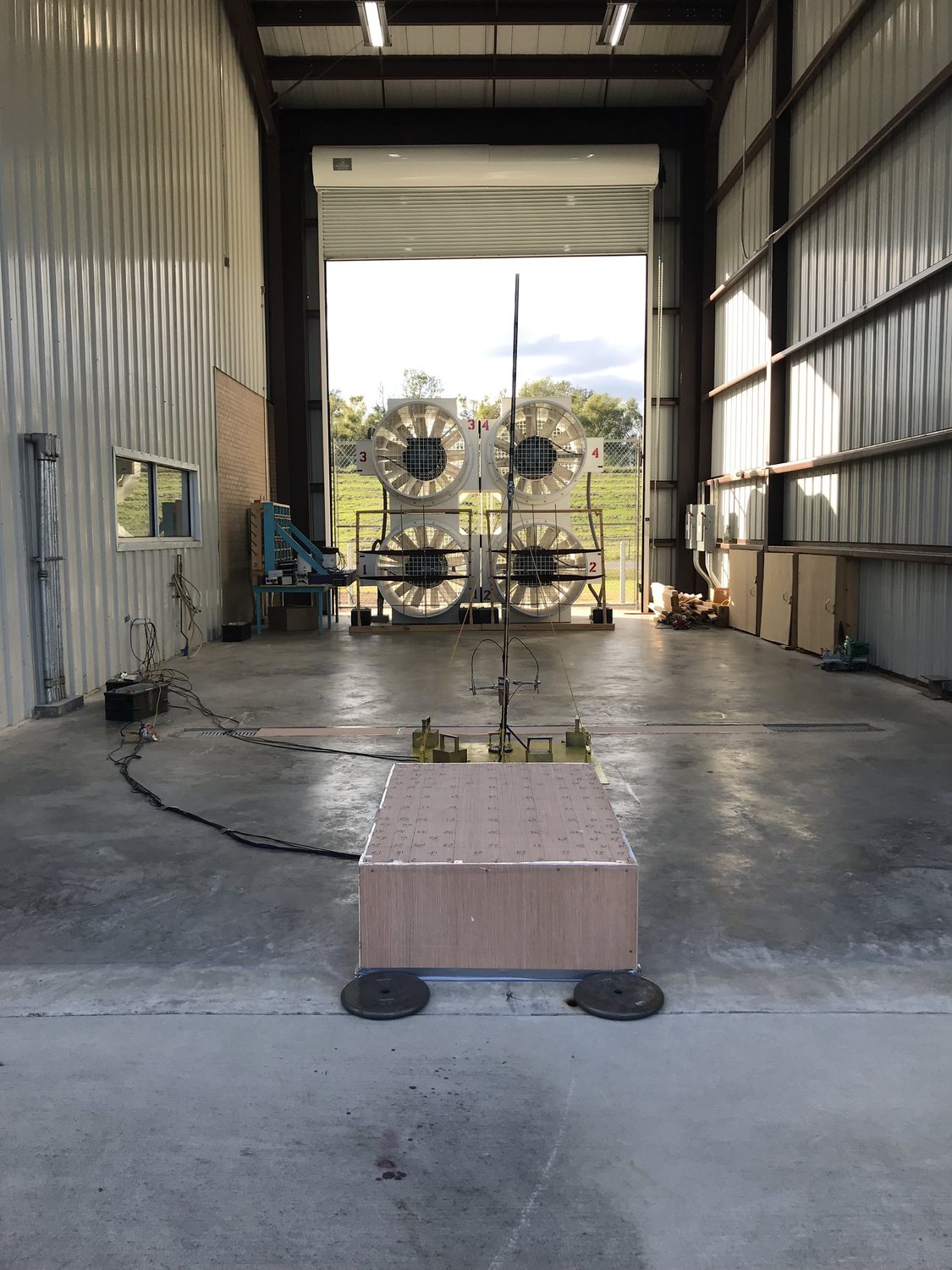
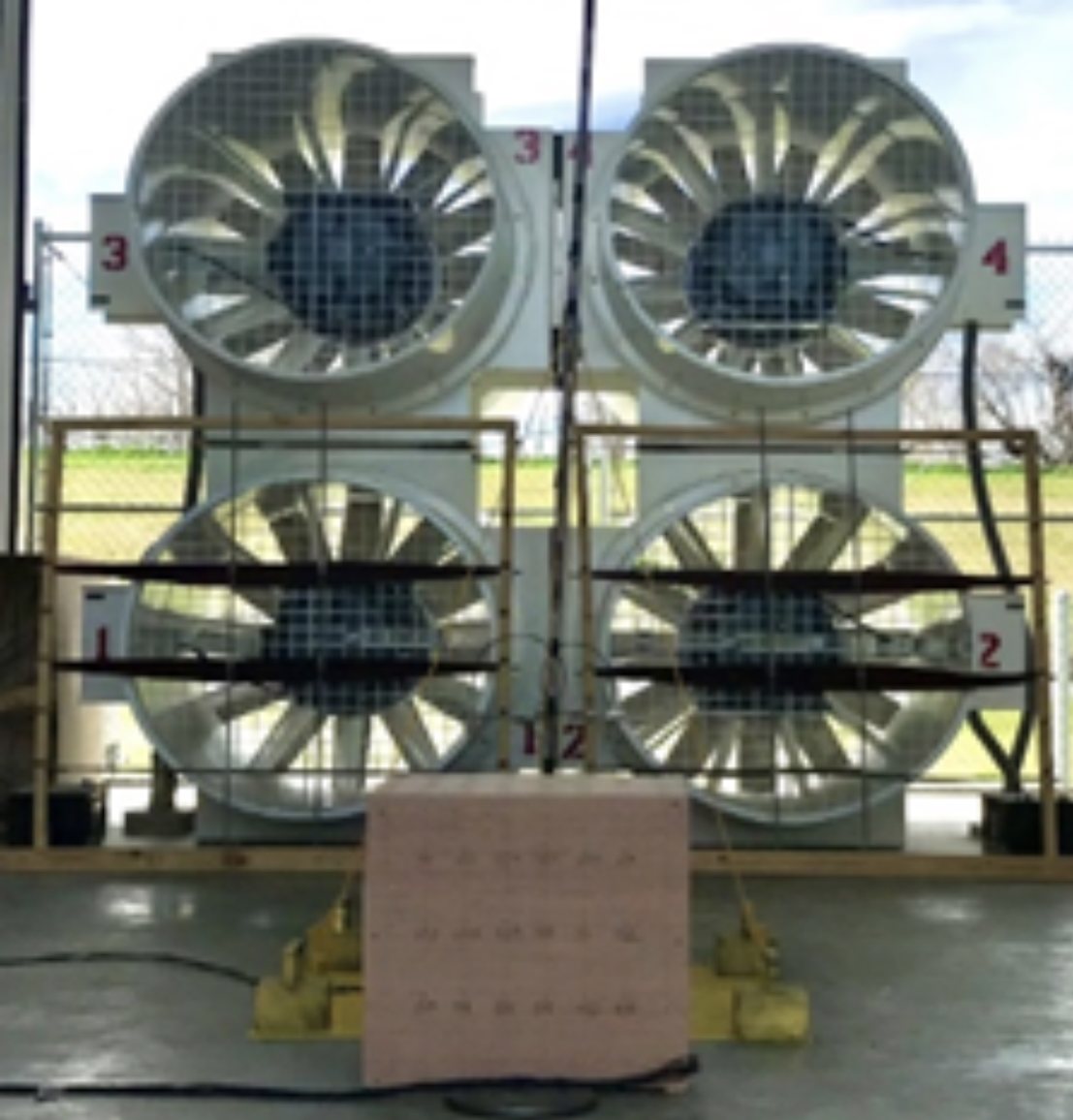
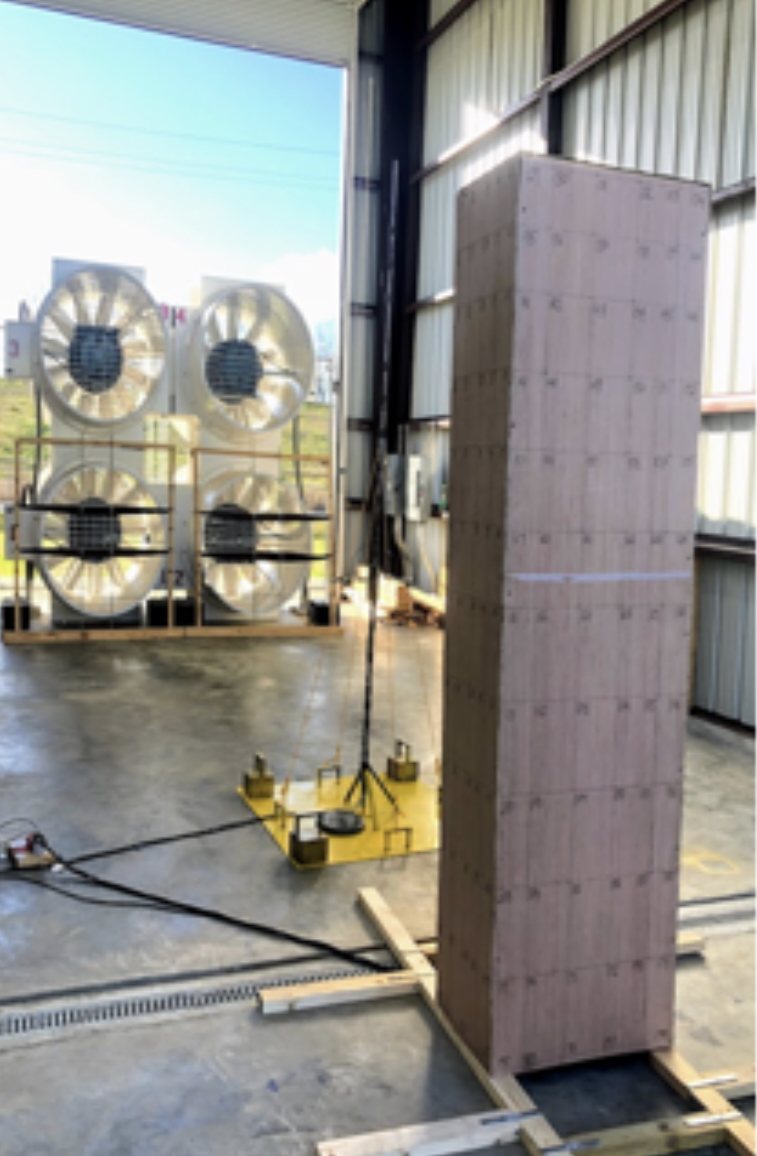
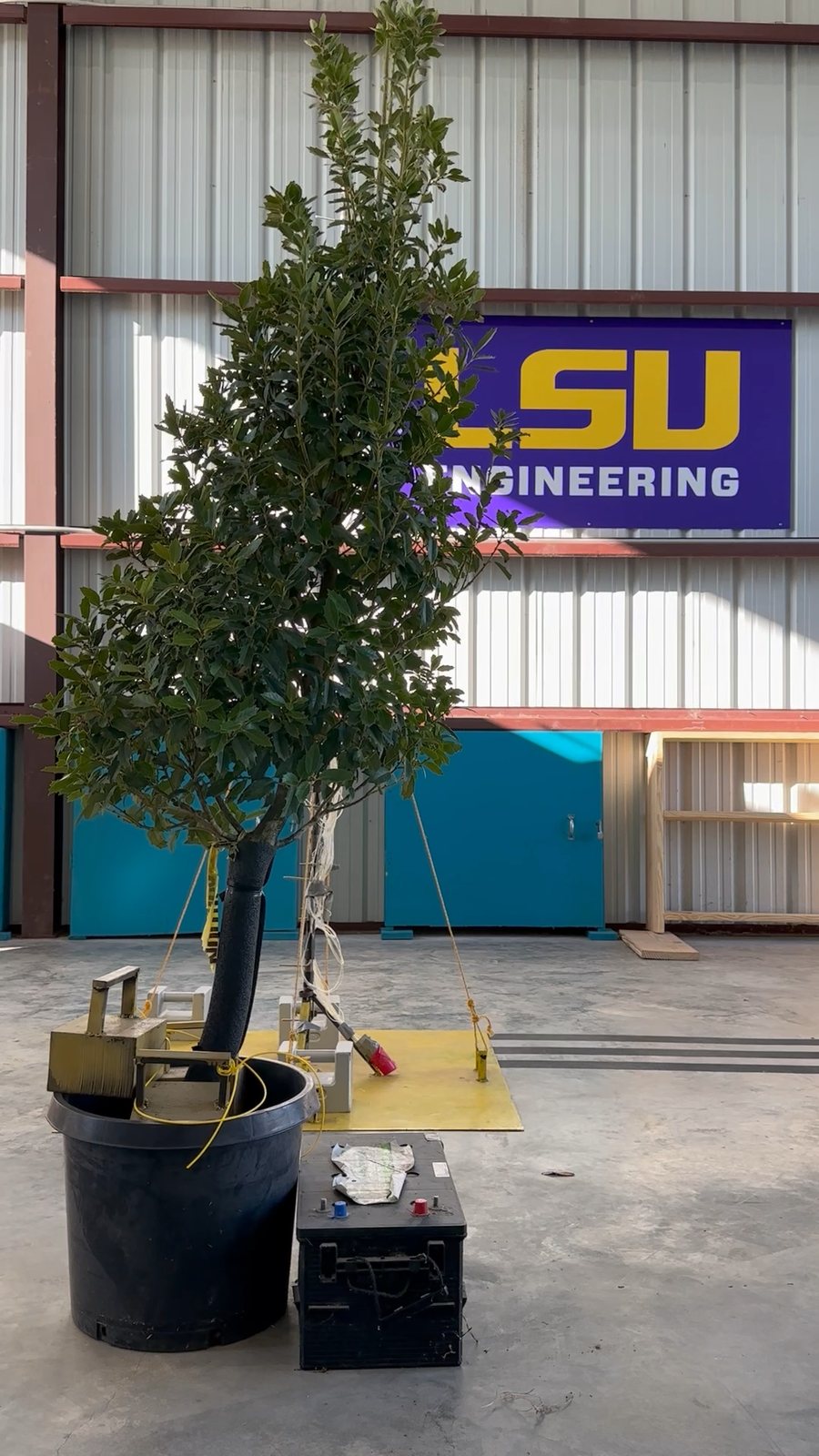
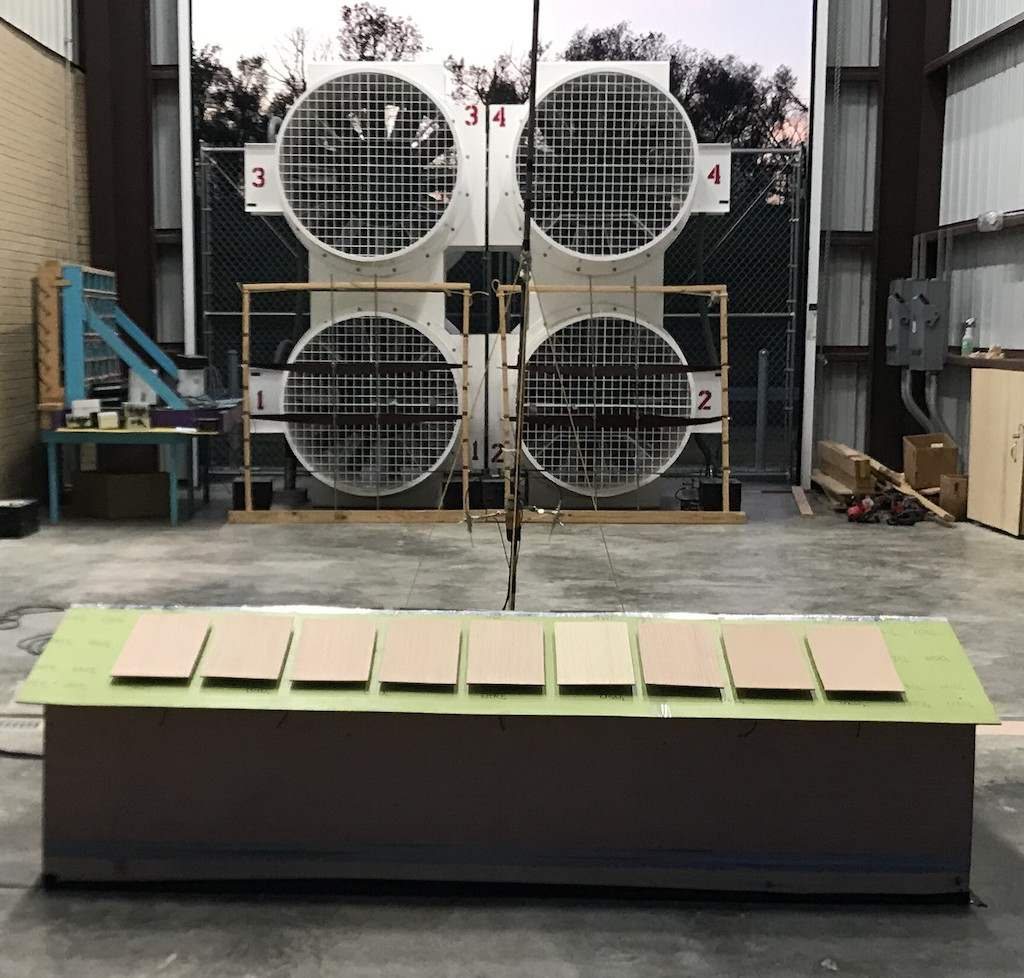
The large-scale open-jet hurricane testing facility at LSU, with its 4 m by 4 m test section, and the laboratories the group uses for structural control and wind tunnel work. Select a photo to enlarge it, or see Facilities.
The open-jet testing hall, with a building model in front of the fan array
A cube building model with pressure taps in front of the four large fans
A 1:50 high-rise building model with pressure taps
A full-size tree before testing
A full-size tree in high wind, tested until its pot overturns
Testing to failure: a building model's roof covering and sheathing tear away
Trees and a mono-slope roof building with a rooftop solar panel in the open jet
2014: students run the group's first open-jet generator and read the flow live
A low-rise building model with rooftop solar panels in front of the fan array
Inside the open-jet testing hallA mono-slope roof building with a rooftop solar panel, instrumented for pressure measurementsA large-scale low-rise building model on the test floorA 1:7.5-scale gable-roof model with rooftop PV panels and pressure tapsDestructive testing at high wind speedA bridge-deck sectional model in front of the open-jet fan arrayShake-table test of the tuned pendulum pounding mass damperPressure tubing inside the 1:50 high-rise model
Open-jet instrumentation includes two Cobra probes for three-component velocity, five accelerometers, two load cells, and a 256-channel pressure measuring system, with a shake table, four MR dampers, and a laser displacement sensor for smart-structure studies.
What we study
Four core lines of work, from measuring wind loads at large scale to predicting them with machine learning and controlling how structures respond.
Large-scale open-jet testing
The LSU WISE open-jet facility reproduces complete atmospheric boundary-layer turbulence at Reynolds numbers up to 2.3 × 10⁶, depending on the test model, with integral length scales about ten times those of conventional small-scale testing.
Measured surface pressures agree closely with full-scale field data and run 25–300% higher than small-scale tests (Physics of Fluids, 2024).
Aerodynamics, CFD, and machine learning
Coupling machine learning with computational fluid dynamics to predict wind loads at a fraction of the cost, with extensions to turbulence modeling for RANS simulations and to the unsteady aerodynamics of pitching and plunging airfoils (AIAA Journal, 2026).
Wind loads on solar panels predicted up to 10,000 times faster than conventional CFD, with accuracy preserved (Sustainable Cities and Society, 2023).
Structural dynamics, smart structures, and control
Smart dampers and tuned pendulum pounding mass dampers that reduce vibration in tall buildings and wind turbines under wind and earthquake loads, verified in experiments (Soil Dynamics and Earthquake Engineering, 2023).
Wind loads and aeroelastic stability of rooftop and ground-mounted solar arrays, solar trackers, and agrivoltaic systems that share land between crops and energy.
75 peer-reviewed journal articles, 3 edited books, 6 book chapters, and 1 U.S. patent. More than 3,200 citations and an h-index over 30 (Google Scholar). 7 Ph.D. and 19 M.S. graduates, now at Texas Tech University, Geosyntec, Brown & Brown, Anchor QEA, HNTB, Fluor, Stantec, Tetra Tech, and other organizations. Course evaluations average 4.50 of 5 across 18 evaluations since 2019, and 4.82 in graduate courses.
AA
Aly Mousaad Aly, Ph.D., P.E.
Associate Professor, Department of Civil and Environmental Engineering, Louisiana State University, and Director, WISE Research Group
Trained as a mechanical engineer (B.Sc. and M.Sc., Alexandria University; Ph.D., Politecnico di Milano), Dr. Aly works where fluid mechanics meets structural dynamics. Before joining LSU in 2013, he was a postdoctoral researcher at Florida International University’s International Hurricane Research Center, an assistant professor of mechanical engineering at Alexandria University, and a research fellow at Western University’s Boundary Layer Wind Tunnel Laboratory. He founded and directs the WISE Research Group, established the LSU WISE open-jet facility, and is a licensed Professional Engineer in Louisiana.
ASCE State-of-the-Art of Civil Engineering Award, 2026 (co-recipient)
ASCE Engineering Mechanics Institute Distinguished Service Award, 2024, as chair of the Fluid Dynamics Committee (2022–2024)
U.S. Air Force Research Laboratory Summer Faculty Fellow, 2022 and 2023
Editor, Wind and Structures; Associate Editor, ASCE Journal of Structural Design and Construction Practice; Guest Editor, Communications Engineering (Nature Portfolio)
Recent recognition, publications, and graduations.
2026
ASCE State-of-the-Art of Civil Engineering Award, as co-recipient for the ASCE/SEI book Effects of Climate Change on Life-Cycle Performance of Structures and Infrastructure Systems. ASCE award list
2026
In the 2026 Stanford University/Elsevier list of the most-cited scientists, Dr. Aly ranks in the top 1% of Civil Engineering researchers for career-long impact and the top 0.5% for single-year impact.
2026
“Unsteady Aerodynamics of Pitching and Plunging Airfoils: Impact of Motion-Related Parameters” published in AIAA Journal, 64(6). Read the paper
2026
New edited book: High Rise Buildings: An Interdisciplinary Examination of Structural, Environmental, and Technological Innovations (IntechOpen). Open the book
2026
Amro Zahrawi and Feng Xie complete their Ph.D. degrees.
 WISE Research Group