Projects

28 projects from the group’s testing, simulation, and control work: what was done, what was found, and where it was published.

Large-scale testing

Experiments in the LSU WISE open-jet facility and, before it, in wind tunnels in Milan, London (Ontario), and Miami.

Phase I, 2014: students run the generator and read the flow live

Building the LSU WISE open-jet facility

2013–2017

Dr. Aly designed and built the facility with students in two phases: a 15-fan Phase I prototype, whose first results students presented in 2014 and whose boundary-layer flow was validated with CFD and measurements, then the large-scale open jet, established in 2016–2017 by an eight-investigator team he led as principal investigator. Its 4 m by 4 m test section reproduces complete atmospheric boundary-layer turbulence at Reynolds numbers up to 2.3 × 106, depending on the test model, and permits destructive testing and wind-driven rain studies.

Measurement (2017); Facilities
A building model’s roof covering and sheathing tear away at high wind speed (failure shown in slow motion)

Testing to failure

LSU WISE open jet

The open jet can take a model all the way to failure. In this test, the roof covering and sheathing of a building model tear away at high wind speed, leaving the framing exposed; a full-size tree has also been tested until its pot overturned.

More test videos

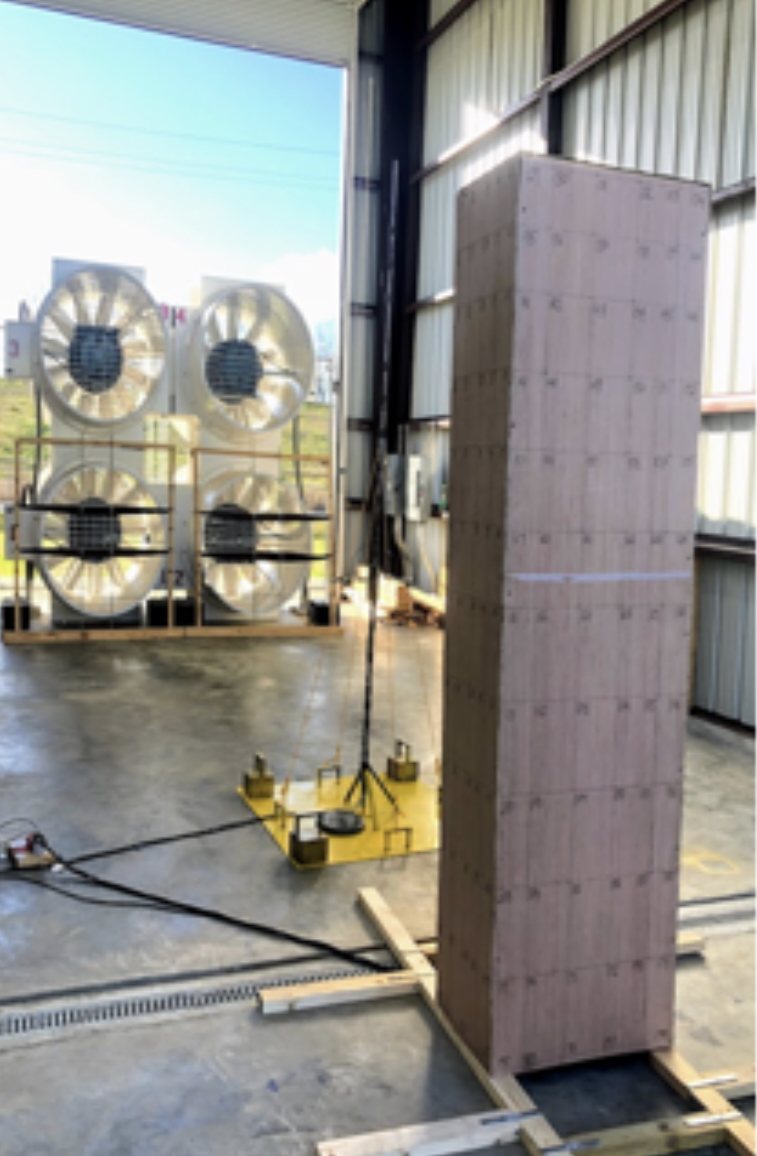
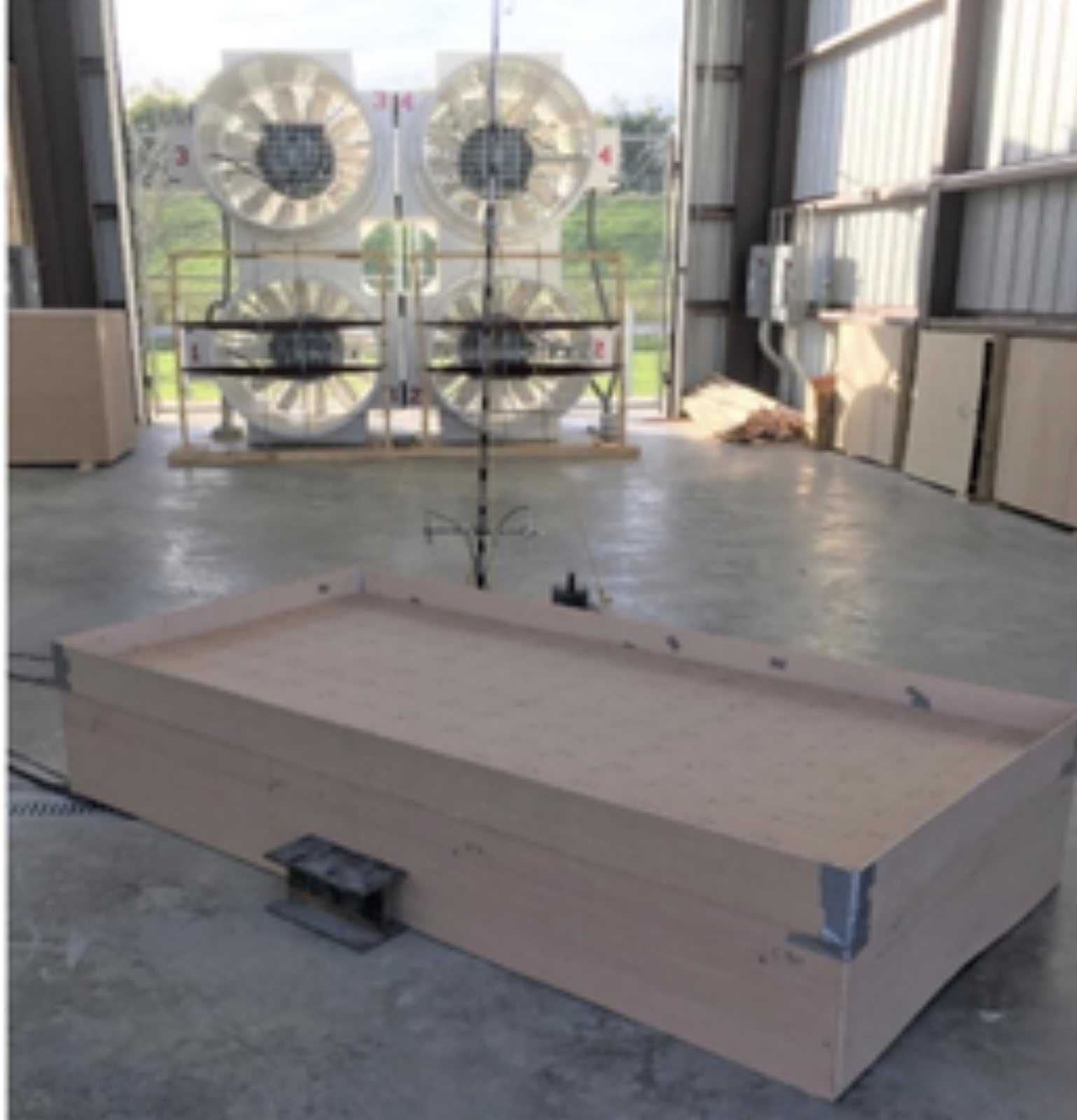
A large-scale low-rise building model on the test floor

A large-scale low-rise building model on the test floor

Turbulence and scale effects in open-jet testing

2022–2024

Building models tested at large geometric scales, at Reynolds numbers of 0.5–1 × 106, produced surface pressures that agree closely with full-scale field data and run 25–300% higher than small-scale tests. The velocity spectra show both small and large eddies, agreeing with established formulations.

Physics of Fluids, 2024; Applied Sciences, 2023

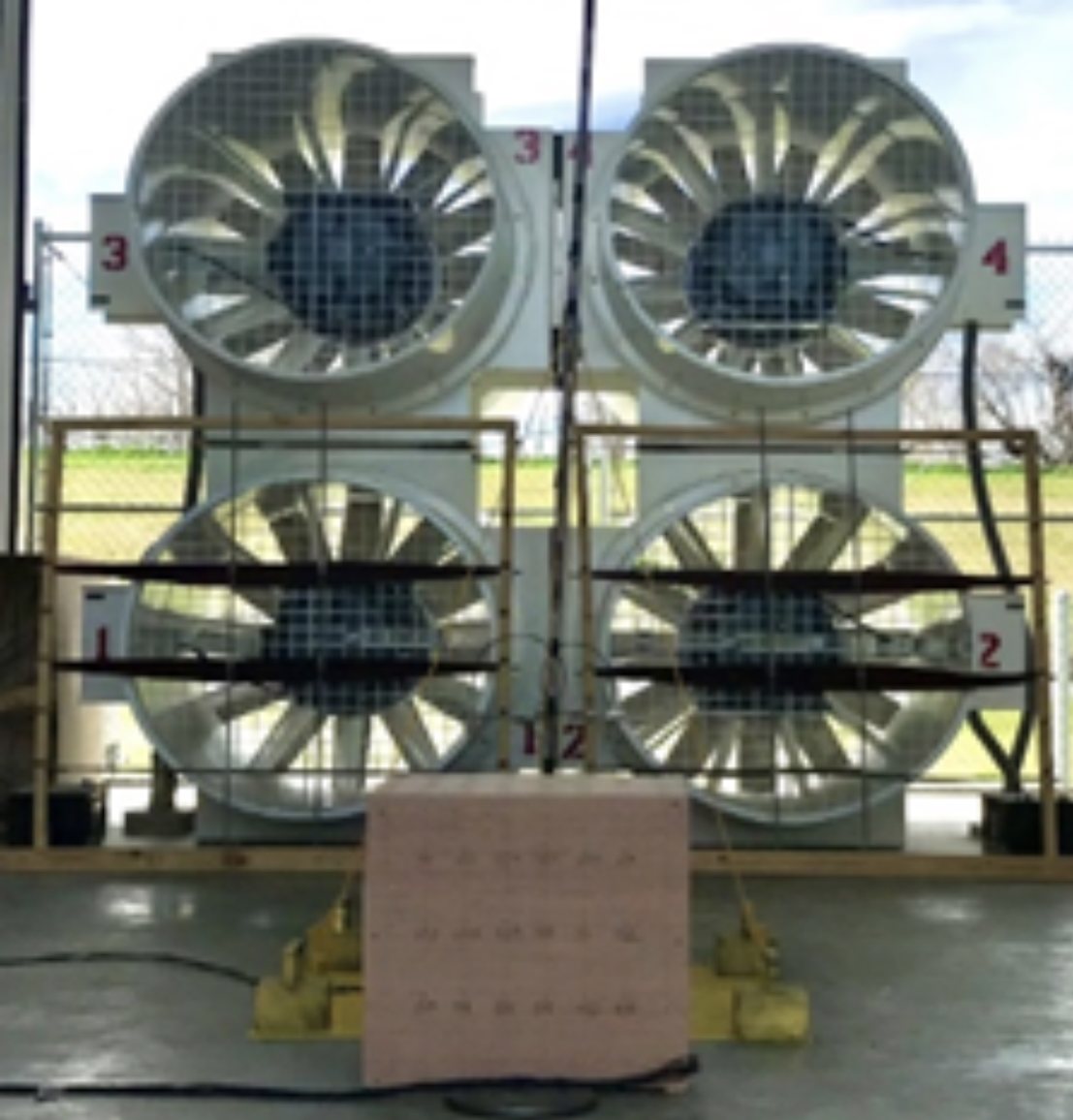
A cube building model with pressure taps in front of the four large fans

A cube building model with pressure taps in front of the four large fans

The Silsoe cube at large scale

2022

Large-scale tests of the Silsoe cube, compared with full-scale and wind-tunnel data, introduced open-jet testing as a tool for structural wind engineering.

Engineering Structures, 2022

The 1:50 high-rise building model

The 1:50 high-rise building model

Cladding pressures on high-rise buildings

2022

On a 1:50 high-rise model instrumented with pressure taps, mean cladding pressures matched those from 1:200 wind-tunnel models while peak pressures ran higher, the pressures that break windows and cladding in storms.

ASCE Journal of Structural Design and Construction Practice, 2022

A full-size tree in the LSU WISE open jet, tested until its pot overturns

Trees under wind: from the Bosco Verticale to the open jet

2011–2013 and later

As lead engineer, Dr. Aly brought a project for Milan’s Bosco Verticale, a high-rise with trees on its balconies, from Politecnico di Milano to Florida International University. Small-scale wind-tunnel tests in Milan captured interference from the surrounding buildings, and full-size trees were tested in FIU’s large open-jet facility, including high-speed tests of how securely the trees held in soil and of a proposed structural mitigation system. At high wind speeds the load coefficients tended to fall, limiting the wind loads on the trees, and no resonance or vortex shedding was observed. Full-size trees have since been tested in the LSU WISE open jet.

Wind and Structures, 17(1), 69–85 (2013)

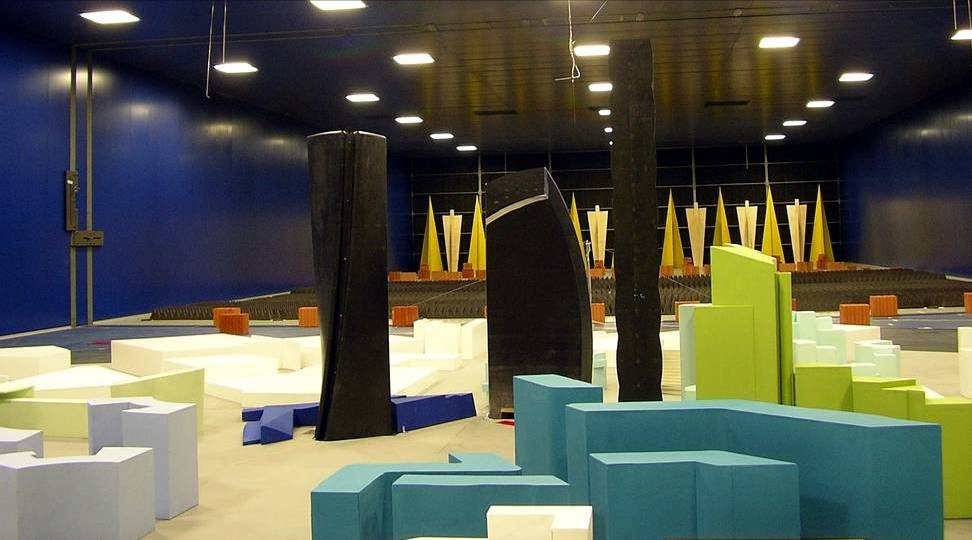
CityLife tower models in the Politecnico di Milano wind tunnel

CityLife tower models in the Politecnico di Milano wind tunnel

Milan’s CityLife towers

2008

Aerodynamic and aeroelastic wind tunnel studies of the Isozaki, Hadid, and Libeskind towers at Politecnico di Milano, using 1:100 models with their surroundings in a boundary-layer flow.

Commissioning the Wall of Wind

2009–2010

At Florida International University’s International Hurricane Research Center, Dr. Aly calibrated the flow-production machines of the Wall of Wind for full-scale hurricane testing and first-authored the facility’s design paper.

ASCE-EMI Special Publication (2013)

Solar energy and agrivoltaics

Wind loads and dynamics of rooftop solar, ground-mounted arrays, single-axis trackers, and agrivoltaic systems.

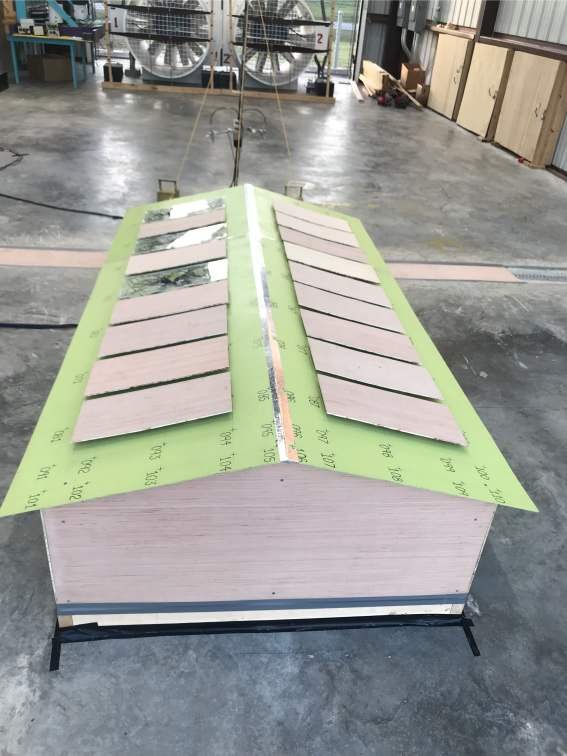
The 1:7.5-scale gable-roof model with rooftop PV panels and pressure taps

The 1:7.5-scale gable-roof model with rooftop PV panels and pressure taps

Rooftop solar on a gable roof

2023

A 1:7.5-scale gable-roof model was tested in four configurations: a bare roof, the roof with panels, panels with racking, and panels with racking and trim and no gaps. The PV arrays reduced total wind-induced roof forces by 45–63%, and the results were compared with design standards.

Sustainable and Resilient Infrastructure, 2023

The mono-slope roof building with its rooftop solar panel and trees, in the open jet

A solar panel on a mono-slope roof

2025–2026, current

A large-scale test of the bare mono-slope roof building validated preliminary CFD simulations. With a rooftop solar panel added, wind forces did not increase, and pressure at the roof’s leading edge fell by 40%. This is current work with a Ph.D. student; the large-scale experiments and simulations of the mono-slope roof building were presented at the 8th International Symposium on Computational Wind Engineering (2026).

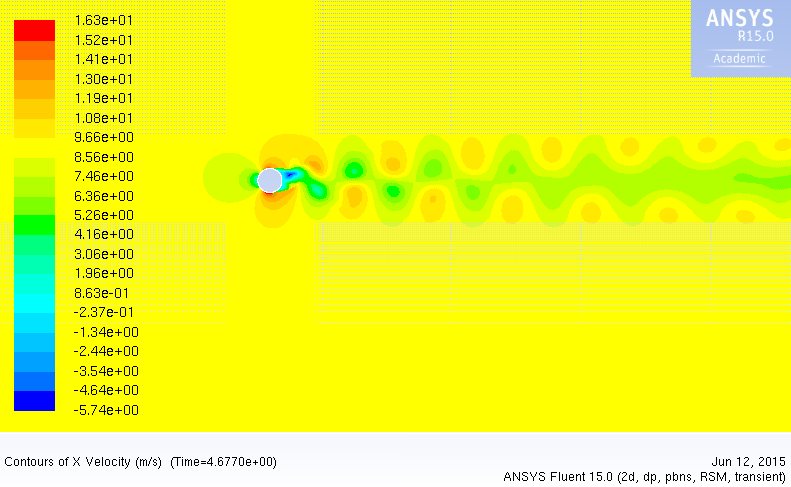
CFD of wind flow around a tilted tracker panel (velocity magnitude)

Single-axis solar trackers

2023–2026

Machine learning coupled with CFD predicted wind loads on tracker panels up to 10,000 times faster than conventional CFD, with accuracy preserved, and identified −15° as the optimal stow angle in high winds. Doctoral research followed on torsional galloping, an aeroelastic instability of trackers.

Sustainable Cities and Society, 2023

Decay test: a single-axis solar tracker displaced by hand and released

Decay test of a single-axis solar tracker

Current work, not yet published

A single-axis solar tracker is displaced by hand and released. Its free-vibration decay shows the natural frequency and damping of its twisting motion, the properties that govern torsional galloping, an aeroelastic instability of trackers in wind.

Solar farms and hurricanes

2022–2025

A comparative study of wind forces on ground-mounted solar arrays, and a case study of a solar farm hit by Hurricane Maria: rebuilding raised costs by 50%, while designing for accurate wind loads in the first place would have raised initial costs by only 2%.

Applied Solar Energy (2022); white paper (2025)

CFD and machine learning

Large-eddy and Reynolds-averaged simulation, made faster and more accurate with machine learning.

Large-eddy simulation of flow over a forward- and backward-facing step (velocity magnitude)

Machine learning for turbulence modeling

2024

Large-eddy simulations, including flow over a forward- and backward-facing step, trained a deep-learning model of eddy viscosity that improves RANS predictions in separated flows. The ML-based approach took about 6 minutes, against about 24 minutes for k-ε, 45 minutes for k-ω SST, and 182 hours for LES.

Journal of Applied Fluid Mechanics, 2024

Vortex wake behind a NACA0012 airfoil in motion

Unsteady aerodynamics of pitching and plunging airfoils

2022–2026

Begun during Dr. Aly’s U.S. Air Force Research Laboratory Summer Faculty Fellowships, this work found that higher motion frequencies increase thrust, thinner airfoils generate more thrust, pivot locations near the leading edge are favorable, and an upstream vortex produces sharp lift transients.

AIAA Journal, 2026

Peak roof pressures with large-eddy simulation

2020–2021

LES of peak roof pressures on low-rise buildings, compared with full-scale and wind-tunnel measurements, and an inflow interpolation approach that lowers the cost of LES without loss of fidelity.

Wind and Structures, 2020; Journal of Building Engineering, 2021

Machine learning and the future of CFD

2025

A sole-authored perspective on how machine learning is reshaping the accuracy and speed of computational fluid dynamics.

Fluids, 2025

Structural dynamics and control

Passive, semi-active, and active control of buildings, wind turbines, and slender structures under wind and earthquakes.

Simulated wind-turbine vibration with and without control

Vibration control of wind turbines

2016–2021

Wind turbines face wind, waves, and earthquakes. The group studied their vibration under single and multiple hazards, proposed a pendulum pounding damper for turbine towers, and reviewed structural control and vibration issues in wind turbines.

Structural Control and Health Monitoring, 2018; Engineering Structures, 2020; Engineering Structures, 2021; Journal of Energy and Power Technology (2021); IET book chapter (2021)

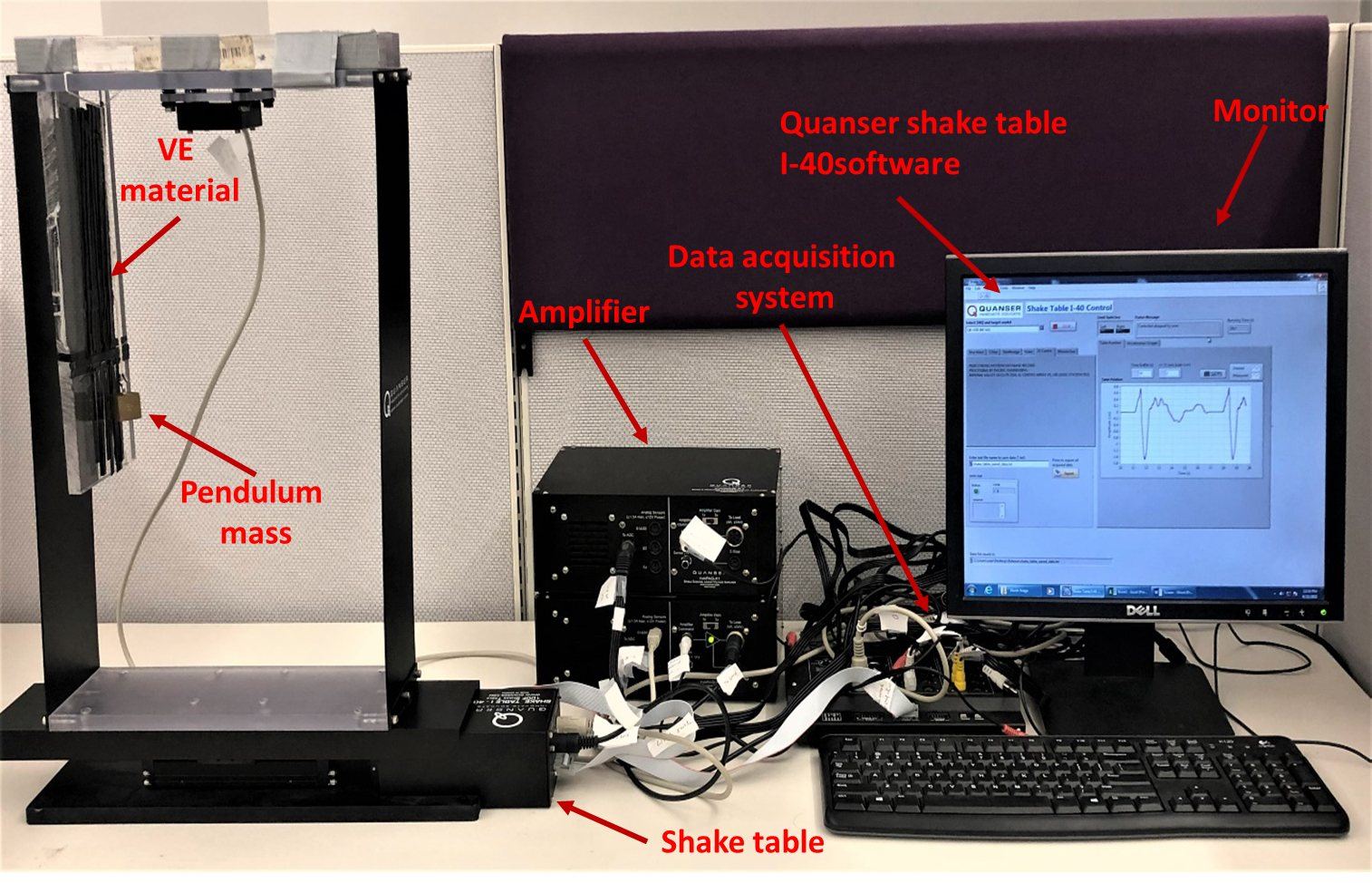
Shake-table test of the tuned pendulum pounding mass damper

Shake-table test of the tuned pendulum pounding mass damper

A tuned pendulum pounding mass damper

2021–2023

A pendulum mass that pounds against a viscoelastic surface near static equilibrium is more robust than a conventional tuned mass damper. Shake-table experiments showed reductions of 55.7% in base shear, 41% in base moment, and 40% in inter-story drift ratio.

Soil Dynamics and Earthquake Engineering, 2023

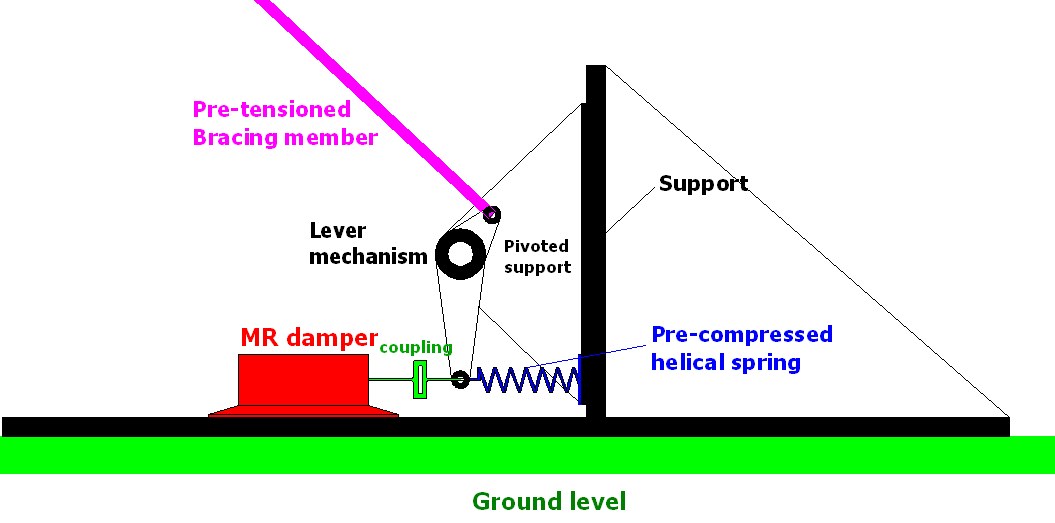
Drawn in AutoCAD during Dr. Aly’s Ph.D.: an MR damper with a lever mechanism, a pre-tensioned bracing member, and a pre-compressed spring

Drawn in AutoCAD during Dr. Aly’s Ph.D.: an MR damper with a lever mechanism, a pre-tensioned bracing member, and a pre-compressed spring

Smart dampers and semiactive control

2005–2019

Magneto-rheological (MR) dampers with lever mechanisms and bracing for tall buildings; an energy-based probabilistic measure of smart-damper efficacy; fast hybrid testing of controlled smart dampers on nonlinear structures, begun at the University of Connecticut in 2007; and a physics-based theory of semiactive control gains built on a Lyapunov function.

The Structural Design of Tall and Special Buildings, 2011; Smart Materials and Structures, 2008; Arabian Journal for Science and Engineering, 2014; Journal of Structural Engineering, 2019

Wind, waves, and water

Where wind meets water: offshore wind turbines and scour at foundations.

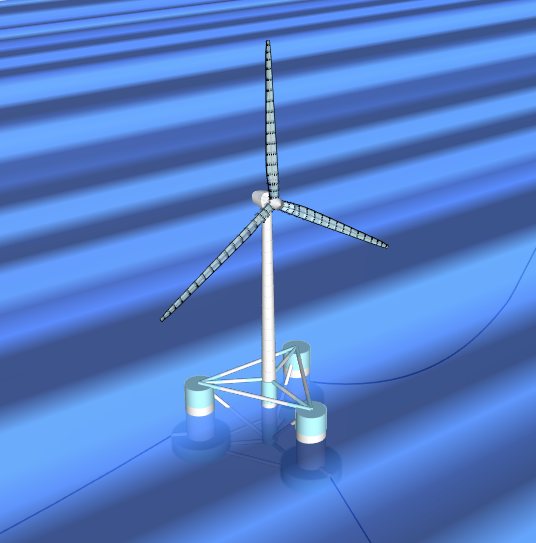
A floating offshore wind turbine under wind and waves (illustration from the 2024 review)

A floating offshore wind turbine under wind and waves (illustration from the 2024 review)

Floating offshore wind turbines

2012–2013 and 2024

At Western University’s Boundary Layer Wind Tunnel Laboratory, Dr. Aly designed and ran experiments on offshore wind turbines. A 2024 review with an M.S. student synthesizes how waves and platform motion, including surge, change the aerodynamic performance of floating offshore wind turbines.

Journal of Structural Design and Construction Practice, 2024

Scour at bridge piers and monopiles

2021–2023

CFD showed that flow attachments such as a delta vane reduce bed shear stress, and with it scour, at bridge piers, elevated buildings, and monopile wind-turbine foundations; large-eddy simulation captured the scour-driving flow better than RANS.

Ocean Engineering, 2021; Journal of Applied Fluid Mechanics, 2023

Transportation infrastructure

Protecting bridges, signs, and signals from wind and traffic.

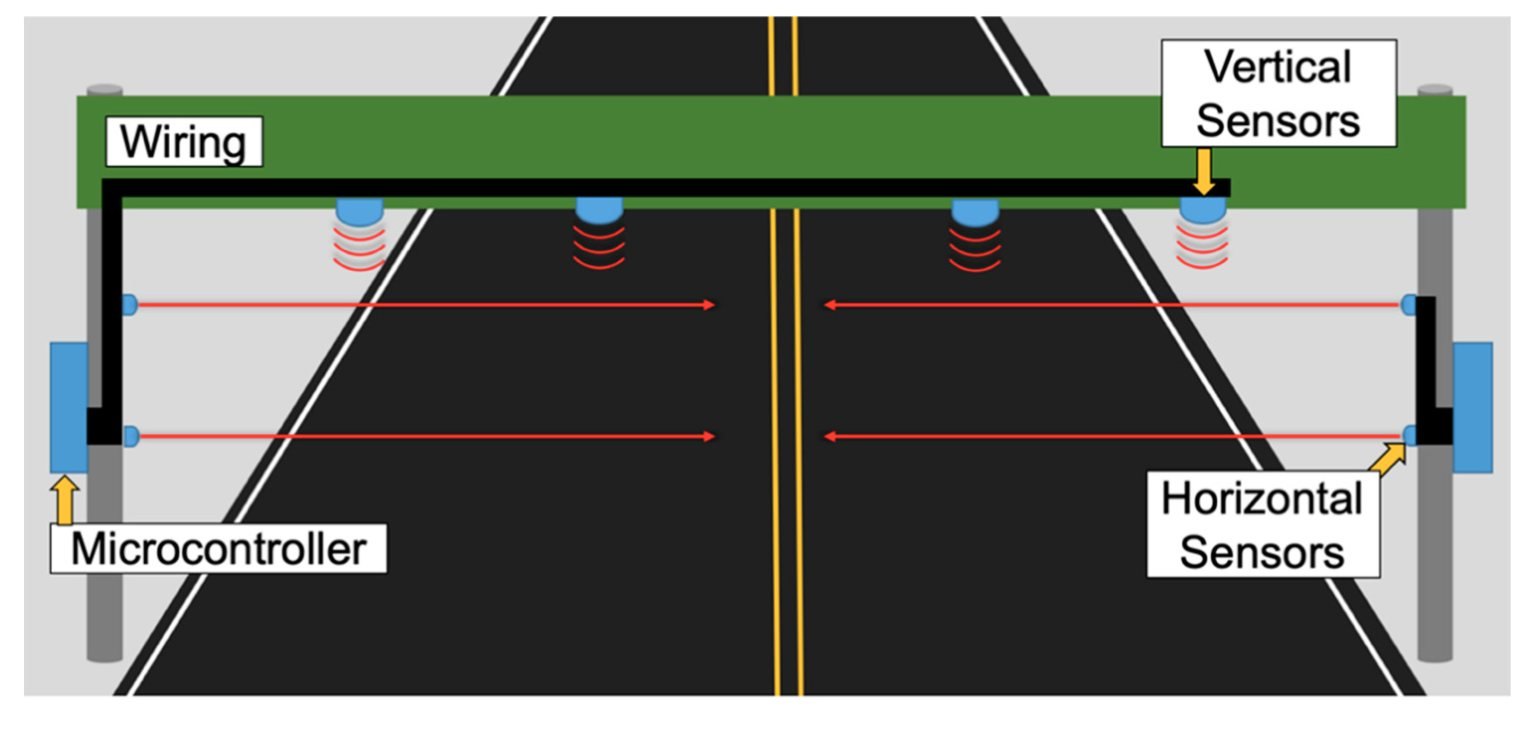
The patented system: vertical and horizontal sensors, wiring, and a microcontroller

The patented system: vertical and horizontal sensors, wiring, and a microcontroller

Overheight vehicles: detection and protection

2020–2024

A sensor network on highway signs or under intersecting bridges detects overheight vehicles and warns drivers before impact (U.S. Patent 12,049,233 B2, 2024). In the case study behind it, a sandwich sacrificial cushion of high-impact rubber reduced a girder’s lateral deflection by 89% and stresses in the girder’s bottom flange and the vehicle’s top by 82% and 25%.

U.S. Patent 12,049,233 B2; Steel and Composite Structures, 2022; TRB Annual Meeting (2024)

CFD of vortex shedding behind a mast arm

CFD of vortex shedding behind a mast arm

Traffic mast arms and overhead signs

2021–2023

Field monitoring, CFD, and vibration mitigation for traffic signal mast arms, and wind loads on overhead sign structures.

Experimental Techniques, 2021; Applied Sciences, 2023

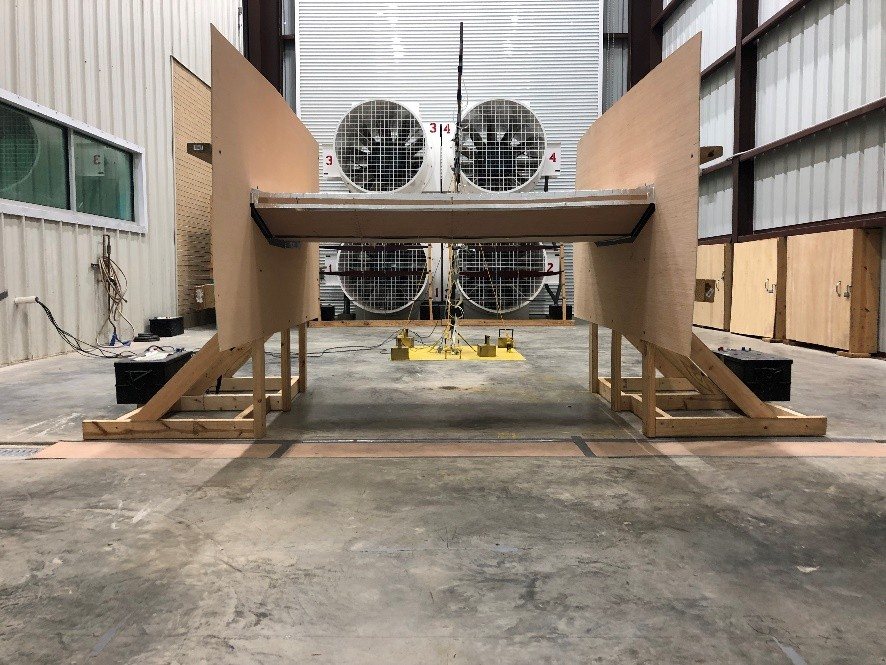
A bridge-deck sectional model in the open jet

A bridge-deck sectional model in the open jet

Bridge aerodynamics in the open jet

2023–2025

An M.S. thesis on aerodynamic mitigation in bridges, tested with a bridge-deck sectional model in the open jet, became a journal paper on Reynolds-number effects and green-energy integration.

Wind, 2025

Work on projects like these

Students in the group run these experiments and simulations, and publish them.

How to join